Deutsch
 中文
中文Wuheng Indoor Climate System vs Radiant Cooling Explained
views: 678 time: 2026-07-06
views: 678 time: 2026-07-06
As homeowners increasingly seek healthier, quieter, and more comfortable living environments, two concepts are gaining worldwide attention: the Wuheng Indoor Climate Systemand the European Radiant Cooling System.
Because both emphasize thermal comfort, energy efficiency, and healthy indoor environments, they are often considered equivalent. In reality, they represent two fundamentally different concepts.
A radiant cooling system describes how indoor comfort is delivered.
A Wuheng Indoor Climate System defines what indoor comfort should ultimately achieve.
Understanding this distinction is essential for architects, HVAC engineers, and homeowners when selecting the most suitable climate solution.
Unlike conventional HVAC technologies,Wuheng is not a product or a single HVAC system.It is a comprehensive indoor climate philosophy centered on five measurable environmental objectives:
Together, these five dimensions create a healthier and more comfortable indoor environment.
As emphasized by Linan Chen, founder of MENRED,
"Buildings should adapt to people—not people adapt to buildings."
This philosophy represents the core value of Wuheng. While reducing energy consumption remains important, energy efficiency is never the final objective. The ultimate purpose is to create indoor environments that continuously support human thermal comfort, health, and wellbeing.
By contrast, a Radiant Cooling System is a technical solution.
According to ASHRAE, radiant cooling removes sensible heat primarily through cooled ceilings, walls, or floors, where radiant heat transfer accounts for more than 50% of the total heat exchange. Because radiant surfaces cannot effectively remove moisture, these systems are typically paired with a dedicated ventilation system that independently manages fresh air and humidity.
This engineering principle is known as independent temperature and humidity control, one of the foundations of modern high-performance HVAC design.
In short:
One question is often raised by international HVAC professionals:
If Europe pioneered radiant cooling technology, why did the Wuheng concept emerge in China?
The answer lies in climate diversity.
Unlike many European countries, which generally experience relatively moderate climates, China spans multiple climate zones—from severe cold regions in the north to tropical climates in the south. Within a single country, buildings may face completely different environmental challenges, including freezing winters, hot and humid summers, prolonged rainy seasons, and significant seasonal temperature variations.
As a result, no single HVAC technology can provide the optimal solution for every climate or every building.
For example:
These diverse climatic conditions encouraged Chinese engineers to move beyond individual HVAC technologies and focus instead on thedesired indoor environment.
Rather than asking,"Which HVAC system should be installed?", the more fundamental question became:
"What indoor environment should people experience, regardless of climate or technology?"
This shift in thinking gave rise to the Wuheng philosophy.
Instead of being defined by a particular piece of equipment, Wuheng establishes five measurable environmental objectives:
Different climates, building types, and user requirements may call for different engineering solutions, but they all pursue the same indoor climate objectives.
In this sense, Wuheng is not another HVAC product category. It is aperformance-oriented indoor climate frameworkthat allows multiple technical approaches—including radiant systems, water-based systems, and all-air systems to achieve the same measurable comfort goals.
This philosophy reflects a broader evolution in HVAC engineering:from selecting technologies to designing indoor environments around human wellbeing.
The Wuheng philosophy can be realized through multiple engineering approaches depending on climate conditions, building type, and project requirements.
Today, three major technical routes dominate the market.
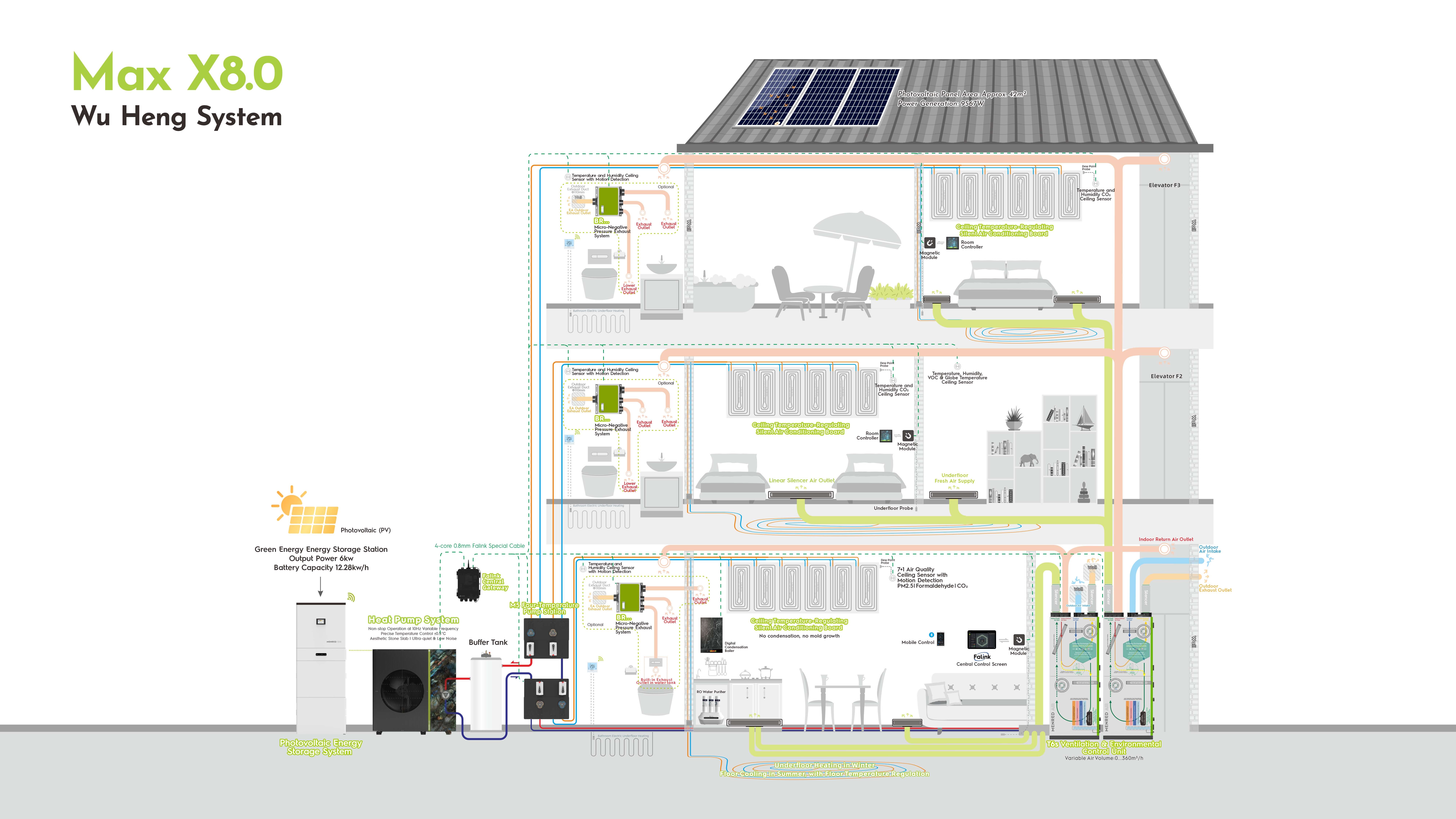
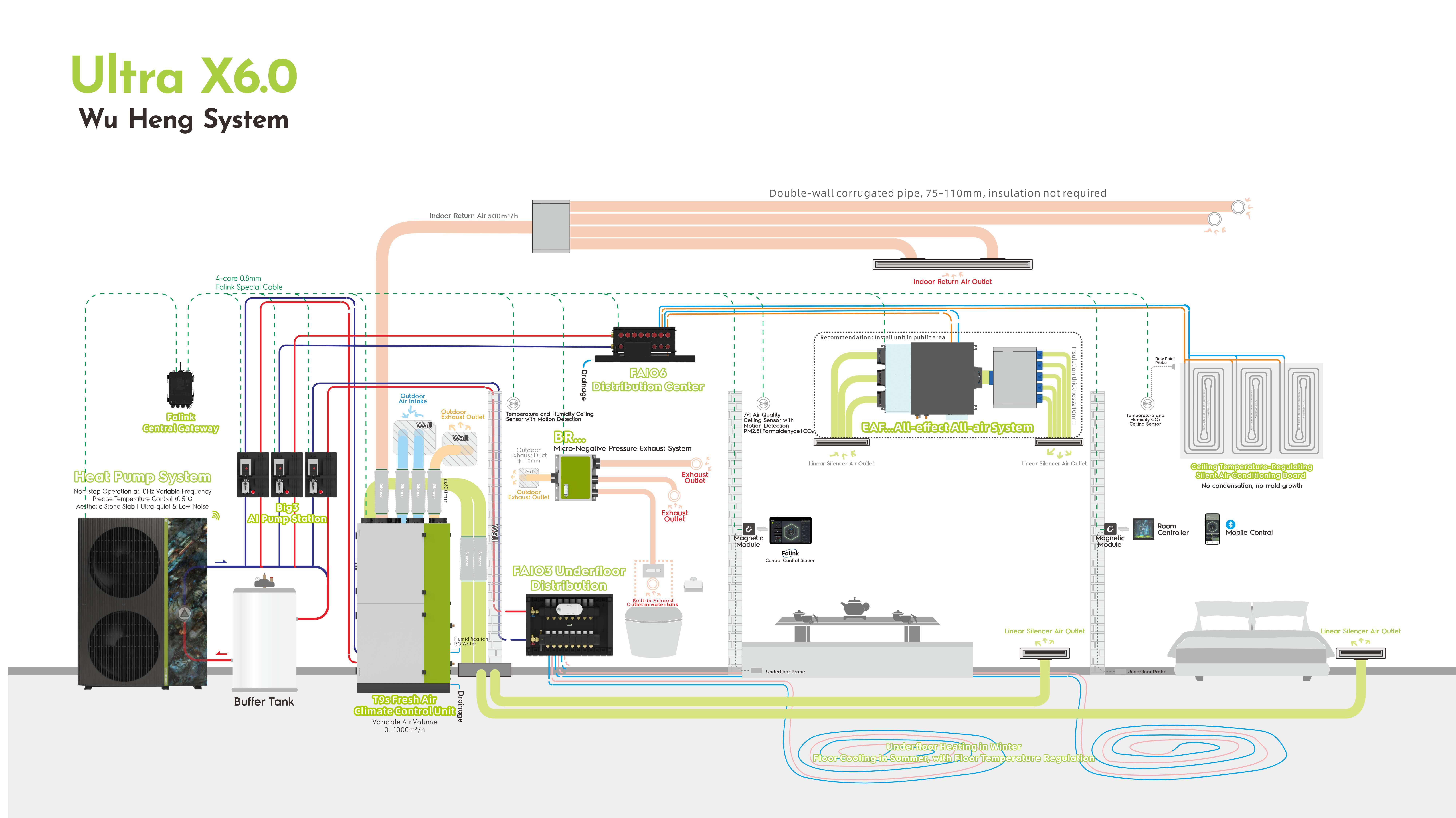
1. Full Radiant Wuheng System
The Full Radiant Wuheng System represents the highest standard of residential indoor comfort.
Its architecture combines radiant ceilings, walls, or floors with an independent fresh air system responsible for ventilation, humidity control, and condensation prevention.
Radiant terminals handle sensible heating and cooling, while the fresh air system independently controls latent loads.
This separation allows each subsystem to operate under optimal conditions.
Key benefits include:
Because no indoor fans are required, helping achieve the Stable Quietness objective of Wuheng.
The primary engineering challenge is condensation prevention. Surface temperatures must always remain above the indoor dew point, requiring intelligent humidity control and continuous dew-point monitoring.
2. Water-Based VRF (WVRF) Wuheng System
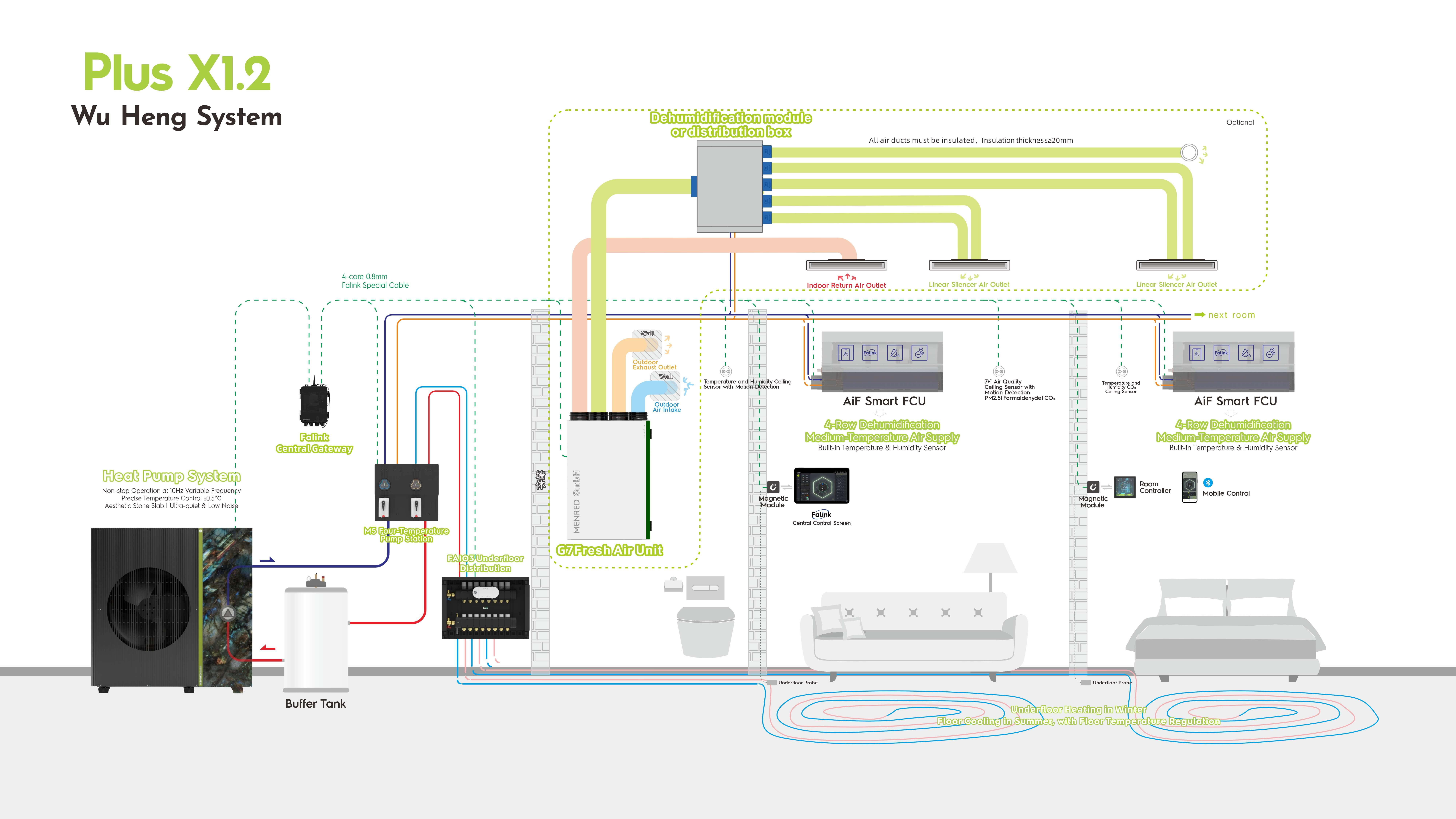
Water-based Variable Refrigerant Flow (WVRF) systems provide another practical route toward Wuheng, particularly for renovation projects or buildings requiring flexible zoning.
Unlike conventional VRF systems, which distribute refrigerant directly throughout occupied spaces, WVRF transfers cooling energy to water before entering the building.
Water—not refrigerant—is distributed indoors.
This architecture offers several important advantages:
Comfort levels are significantly higher than conventional split systems, although cooling still relies primarily on air convection. Occupants may perceive some air movement, fan noise, and temperature stratification. Indoor fan coils also require routine maintenance because condensate trays can accumulate biological contaminants over time.
3. AHU Wuheng System
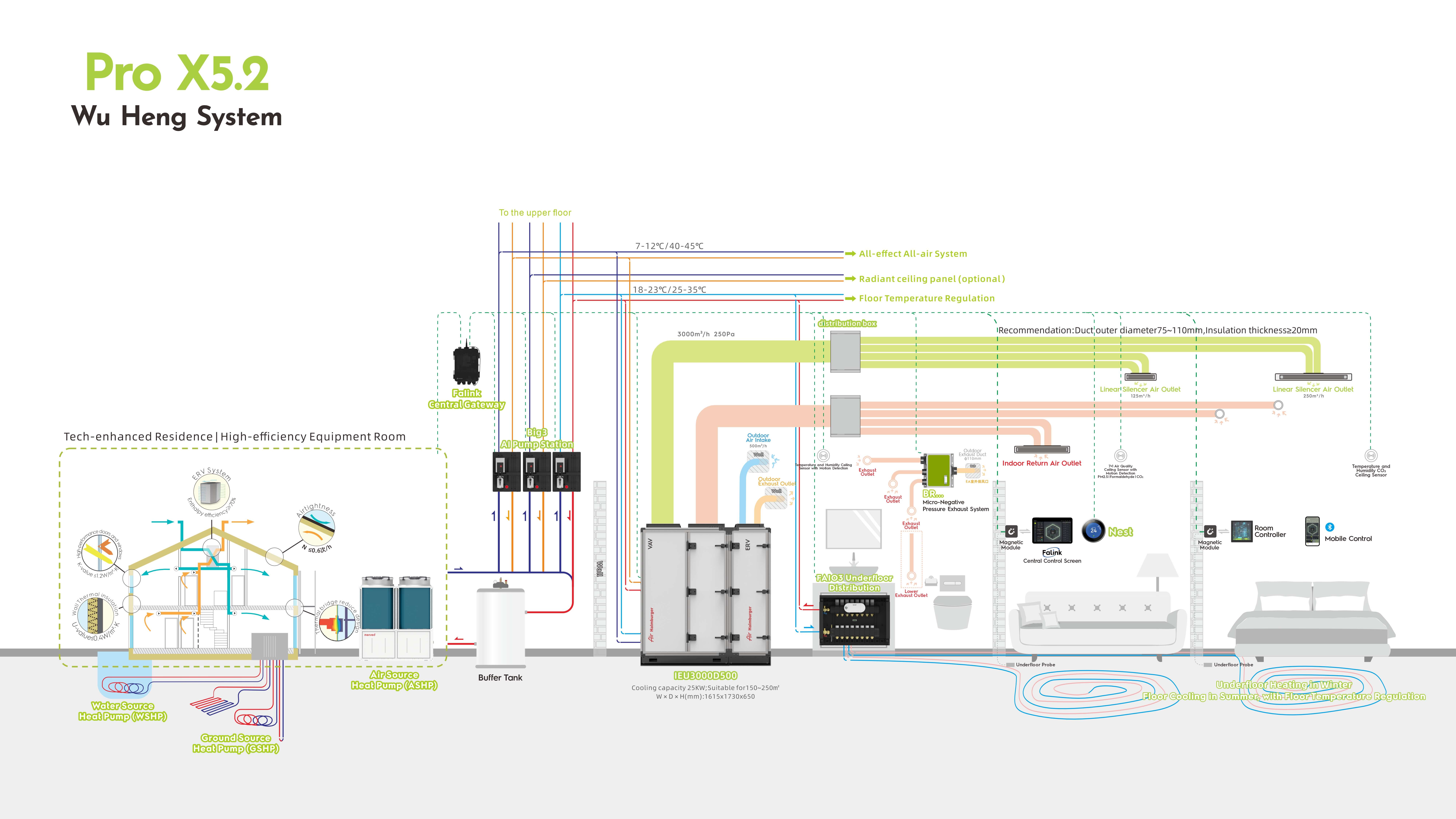
The third technical route relies entirely on conditioned air to regulate indoor climate.
A centralized Air Handling Unit (AHU) manages temperature, humidity, fresh air, filtration, and air distribution through a duct network.
Sharing the Same Scientific Foundation as DOAS
The all-air Wuheng approach shares its theoretical roots with the Dedicated Outdoor Air System (DOAS)concept pioneered by Stanley A. Mumma.
Professor Mumma's research fundamentally changed modern HVAC engineering by demonstrating that ventilation air and latent loads should be managed independently from sensible cooling.
In a classic DOAS configuration, the outdoor air system is dedicated to ventilation and humidity control, while sensible cooling is provided by radiant terminals or other independent systems.
The AHU Wuheng System follows the same scientific philosophy but adopts an integrated residential architecture. Instead of separating sensible cooling into radiant terminals, a centralized air-handling unit simultaneously delivers temperature control, humidity management, air purification, and fresh air distribution through a unified duct system.
This solution has become increasingly popular in premium residential buildings where fast response, high ventilation rates, and simplified maintenance are priorities.
Comparison of the Three Technical Routes for Achieving Wuheng
While all three approaches are designed to deliver the Wuheng Indoor Climate objectives, they differ in engineering principles, comfort performance, installation requirements, and ideal applications.
Performance Criteria | Full Radiant Wuheng System | Water-Based VRF (WVRF) Wuheng System | AHU Wuheng System |
Primary Energy Distribution Medium | Closed-loop hydronic water system | Water indoors, refrigerant confined to outdoor unit side | Conditioned air |
Dominant Heat Transfer Method | Radiant heat transfer (>50%) | Convective heat transfer | Convective heat transfer |
Temperature & Humidity Control Strategy | Independent control of sensible and latent loads | Air-conditioning with dedicated fresh air and humidity control | Integrated air-based control of sensible and latent loads |
Perceived Air Movement | Virtually draft-free | Moderate airflow | Moderate airflow |
Indoor Noise Level | Virtually silent (no indoor fan terminals) | Indoor fan operation (typically ≤35 dB(A)) | Air outlet and duct airflow noise (typically ≤35 dB(A)) |
Temperature Uniformity | Excellent (vertical temperature difference typically ≤1°C) | Moderate (some thermal stratification may occur) | Good (dependent on air distribution design) |
Indoor Hygiene & Maintenance | Closed hydronic circuit with no indoor condensate trays | Indoor fan coils and condensate trays require periodic maintenance | Air ducts and cooling coils require regular cleaning and maintenance |
Individual Room Control | Independent zoning available | Independent room-by-room control | Primarily centralized control with limited zoning |
Building Requirements | High-performance building envelope and condensation prevention design recommended | Flexible installation; well suited for renovation projects | Requires sufficient ceiling space for ductwork and air distribution |
Typical System Configuration | Radiant ceiling/wall/floor + Dedicated Fresh Air System | Water-Based VRF + Fresh Air System | Central AHU + Supply & Return Air Duct System |
Typical Applications | Luxury residences, villas, high-end apartments, premium office spaces | Residential renovations, apartments, hotels, mixed-use buildings | Large residences, villas, schools, commercial buildings requiring centralized ventilation |
Overall Comfort Level | ★★★★★ | ★★★★☆ | ★★★★☆ |
Choosing the Right Wuheng Solution
There is no universally "best" Wuheng system. The most suitable solution depends on the local climate, building characteristics, budget, and occupant expectations.
Regardless of the technical route selected, the objective remains the same:to create a stable, healthy, and comfortable indoor climate centered on human wellbeing.
Modern indoor climate design is fundamentally based on the pioneering work of Povl Ole Fanger, whose Human Heat Balance Theory transformed the understanding of thermal comfort.
Professor Fanger introduced the Predicted Mean Vote (PMV)model, which later became the foundation of ISO 7730, the internationally recognized standard for evaluating indoor thermal environments.
Rather than considering air temperature alone, the PMV model evaluates six interacting variables:
This explains why two rooms maintained at the same air temperature can produce completely different comfort experiences.
MENRED incorporates these internationally recognized scientific principles into the Wuheng Indoor Climate System, ensuring that every performance indicator is measurable, verifiable, and centered on human wellbeing rather than equipment performance alone.
To translate thermal comfort into measurable engineering performance, MENRED defines clear design targets for every Wuheng project.
Indicator | Design Target |
Stable Temperature | ±1°C to ±2°C |
Stable Humidity | Moisture content: ≥6 g/kg in winter, ≤12 g/kg in summer. 40–60% RH |
Stable Oxygen | CO₂ ≤700 ppm |
Stable Cleanliness | PM2.5 ≤25 μg/m³ |
Stable Quietness | ≤35 dB(A) |
These measurable indicators provide architects, engineers, and homeowners with objective criteria for evaluating indoor environmental quality.
Radiant Cooling and Wuheng are not competing concepts.
They operate at different levels.
Radiant Cooling is an advanced HVAC technology.
Wuheng is a comprehensive indoor climate philosophy.
Multiple technical routes—including Full Radiant Systems, Water-Based VRF Systems, and All-Air Systems—can all achieve Wuheng objectives when properly engineered.
The optimal solution depends on climate conditions, building characteristics, occupancy patterns, and project priorities.
For MENRED, the ultimate benchmark is not the equipment itself, but the indoor environment it creates.
AsLinan Chensummarizes the philosophy:
"Buildings should adapt to people—not people adapt to buildings."
Whether achieved through radiant systems, all-air systems, or water-based HVAC technologies, every engineering decision should ultimately serve one purpose: creating healthier, quieter, cleaner, and more comfortable indoor environments.
From Technology Selection to Indoor Climate Design
At MENRED, Wuheng is regarded as more than a collection of HVAC products.
It is a design methodology that integrates architecture, climate, HVAC engineering, intelligent controls, and human comfort into a unified indoor climate strategy.
Instead of asking which equipment is "best," MENRED begins with measurable indoor environmental targets and then selects the most appropriate technical route according to the local climate, building characteristics, and occupant expectations.
Thisperformance-first approachallows one Wuheng philosophy to be implemented through multiple technologies while maintaining the same commitment to healthy, comfortable, and sustainable indoor living.
Economy Park HQs, Yueqing City, China.
Weisswasser Germany
Lingkun Island,Wenzhou City,Zhejiang China.
Nanhu District, Jiaxing City, Zhejiang China.