Deutsch
 中文
中文Why Radiant Cooling Matters: The Science Behind the Wuheng Climate System
Indoor Climate Insights | MENRED
When we talk about indoor comfort, temperature is usually the first thing that comes to mind.
But true indoor comfort is not determined by air temperature alone.
The human body is constantly exchanging heat with the surrounding environment through radiation, convection, conduction and evaporation. Therefore, the temperature of surrounding surfaces, indoor humidity, air movement and air quality all influence how comfortable a space feels.
This is one of the fundamental ideas behind the Wuheng Climate System.
Instead of relying primarily on strong airflow to heat or cool a room, Wuheng combines radiant heating and cooling, ERV ventilation, independent dehumidification, air filtration and quiet water-cooled radiant panels to create a more stable indoor climate.
The goal is simple:
Not just to control the temperature, but to create a stable indoor environment around people.
How Does the Human Body Exchange Heat?
The human body continuously exchanges heat with its surroundings through four main mechanisms:
- Radiation
- Convection
- Conduction
- Evaporation
Among these, radiation and convection are particularly important when we consider indoor thermal comfort.
Imagine a person with a skin temperature of approximately 33°C standing in a room where the surrounding surfaces are around 20°C and the indoor air temperature is around 26°C.
There is a significant temperature difference between the human body and the surrounding surfaces. At the same time, the temperature difference between the body and the indoor air is relatively smaller.
This means that surrounding surfaces can play an important role in how the human body loses heat.
And this is where radiant heating and cooling becomes particularly interesting.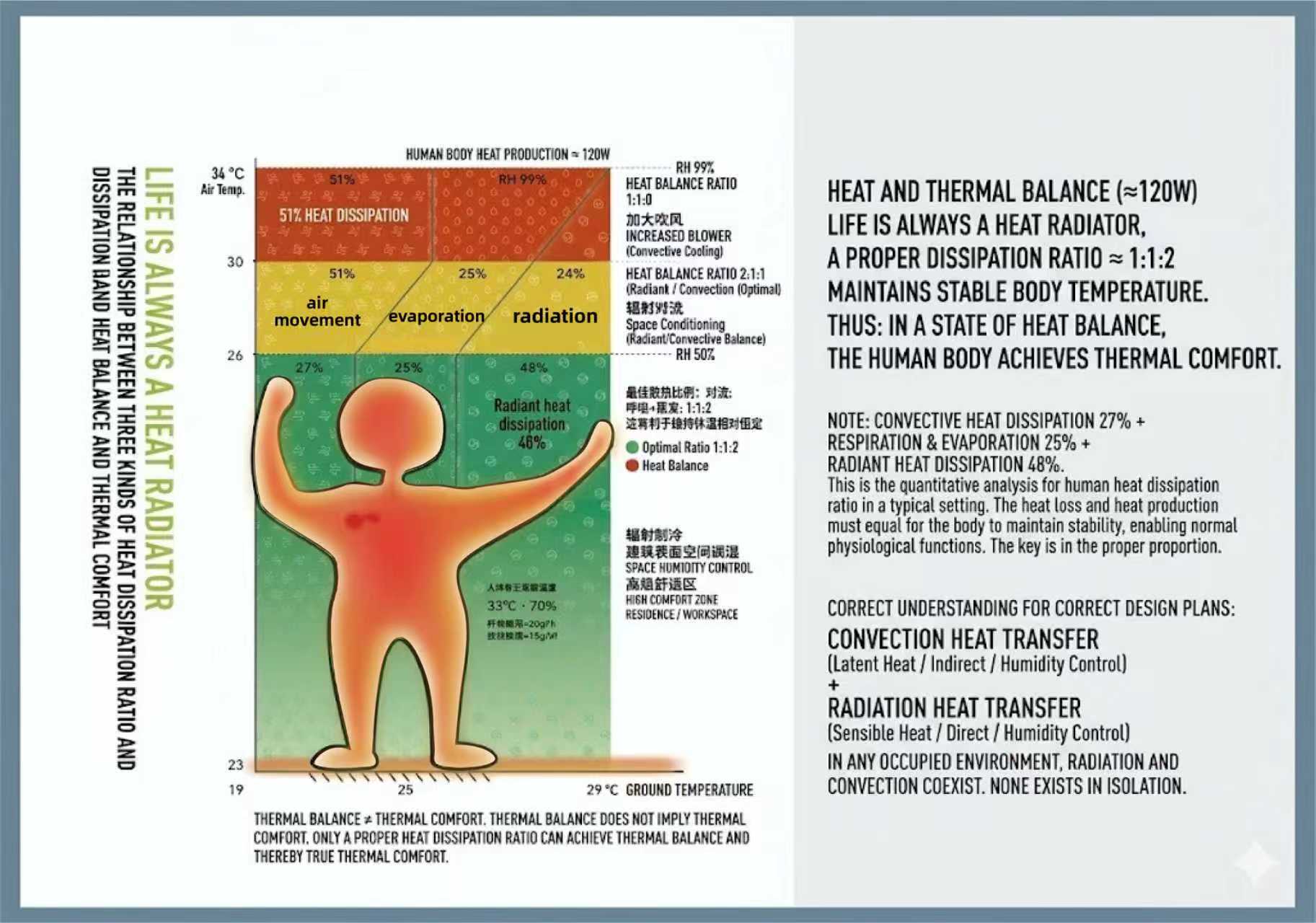
Radiation vs. Convection
Radiation and convection transfer heat in fundamentally different ways.
Radiative heat transfer occurs between surfaces through electromagnetic radiation. It is strongly influenced by the temperature of the surrounding surfaces.
Convective heat transfer occurs between a surface and moving air and depends largely on the temperature difference between the body and the surrounding air, as well as air movement.
In a conventional air-conditioning system, cooling is primarily achieved by lowering the air temperature and circulating that air through the room.
In a radiant system, a large surface — such as a ceiling, wall or floor — becomes an active heat-exchange surface.
Instead of using large amounts of cold air to remove heat, the system can remove heat through the surrounding surfaces.
This creates a fundamentally different approach to indoor comfort.
Why Wuheng Uses Radiant Heating and Cooling
The Wuheng Climate System places radiant heating and cooling at the center of thermal comfort.
The principle is straightforward:
Use large-area radiant surfaces to exchange heat gently and efficiently with the indoor environment.
For cooling, water-cooled radiant panels can absorb heat from the room and from occupants through radiation.
For heating, radiant surfaces provide heat more evenly throughout the occupied space.
Because the system does not rely primarily on high-speed airflow to deliver heating or cooling, occupants can experience:
- Less direct air movement
- More even thermal conditions
- Reduced hot and cold spots
- Lower perceived airflow
- A more natural feeling of comfort
This is the foundation of:
Radiant Heating & Cooling → Stable Temperature
Large Surface Area, Gentle Temperature Difference
One of the key advantages of radiant systems is their large active surface area.
A conventional air-conditioning unit typically uses relatively low supply-air temperatures and higher airflow rates to transfer heat.
A radiant system works differently.
The ceiling, wall or floor itself becomes part of the heat-transfer system.
Because the active surface area is large, the required temperature difference between the radiant surface and the room can be relatively moderate.
This allows the system to provide thermal comfort without creating the strong air movement commonly associated with conventional air conditioning.
For bedrooms, luxury residences, offices and other spaces where comfort and quietness are particularly important, this can make a significant difference.
But Radiant Cooling Alone Is Not Enough
There is an important engineering principle that should not be overlooked:
Temperature and humidity are two different control challenges.
Radiant cooling primarily handles sensible heat — the heat that affects indoor temperature.
Humidity represents latent heat and requires a different approach.
If indoor humidity becomes too high, condensation may occur when a cooled surface reaches or falls below the indoor dew point.
Therefore, a high-performance radiant cooling system needs effective humidity management.
This is why Wuheng does not simply mean "radiant cooling."
It means an integrated indoor climate system.
ERV + Independent Dehumidification for Stable Humidity
The Wuheng approach combines ERV ventilation with independent dehumidification.
The ERV system continuously introduces fresh outdoor air while recovering energy between incoming and outgoing air streams.
At the same time, the independent dehumidification system manages indoor moisture according to the actual humidity load.
Together, they help maintain a more stable indoor humidity environment.
ERV & Dehumidification → Stable Humidity
This separation is important.
The radiant system focuses on thermal comfort.
The ERV system provides continuous ventilation and energy recovery.
The independent dehumidification system focuses on moisture control.
By allowing each subsystem to perform its specific function, Wuheng can manage temperature and humidity more effectively while reducing the need for excessive cooling of the supply air.
ERV for Stable Oxygen
Humidity control is not the only role of the ERV system.
A modern, well-insulated building needs continuous ventilation to maintain good indoor air quality.
The ERV system continuously supplies filtered outdoor air and removes stale indoor air.
This helps manage:
- CO2
- Indoor odors
- Stale air
- Indoor air pollutants
At the same time, energy recovery helps reduce the energy penalty associated with continuous ventilation.
Therefore:
ERV → Stable Oxygen
In the Wuheng Climate System, ventilation is not an occasional function. It is part of the continuous indoor climate management strategy.
Air Filtration + Stable Humidity for Stable Cleanliness
Clean indoor air requires more than simply bringing in outdoor air.
Outdoor air can contain PM2.5, dust, pollen and other particulate pollutants.
The Wuheng Climate System therefore combines ventilation with effective air filtration and purification.
Air Filtration & Purification → Stable Cleanliness
But cleanliness is also closely related to indoor humidity.
Excessive humidity can create conditions that support mold growth and other biological contaminants.
By maintaining a more stable indoor humidity level, Wuheng helps reduce the conditions that support mold growth.
Therefore, Stable Cleanliness is not achieved by filtration alone.
It is the result of combining:
Air Filtration + Air Purification + Stable Humidity Control
to create a cleaner and healthier indoor environment.
Importantly, stable humidity does not mean that mold can never occur. Building materials, ventilation, thermal bridges and local surface conditions also matter.
The goal is to reduce the risk of mold growth through integrated indoor climate control.
Water-Cooled Radiant Panels for Stable Quietness
There is another dimension of comfort that is often overlooked:
Noise.
Traditional air-conditioning systems depend on fans to move large amounts of air.
Even when the temperature is comfortable, the sound of fans, air movement and airflow through ducts can remain noticeable.
Wuheng takes a different approach.
Water-cooled radiant panels transfer heat primarily through water and radiation rather than high-speed air movement.
Water-Cooled Radiant Panel → Stable Quietness
With no high-speed fan required at the room-side radiant terminal, the system can create a much quieter indoor environment.
This is particularly valuable in:
- Bedrooms
- Living rooms
- Luxury residences
- Hotels
- Offices
- Quiet working spaces
The ideal HVAC system is often the one you barely notice.
You feel the comfort — but you don't feel the equipment.
One Integrated System, Five Stable Conditions
This is the fundamental difference between Wuheng and a conventional air-conditioning approach.
Wuheng does not treat heating, cooling, ventilation, humidity, air purification and noise as isolated problems.
Instead, they are coordinated as one indoor climate system.
The Five Stable Conditions of Wuheng
| Wuheng Objective | Key Technology |
|---|---|
| Stable Temperature | Radiant Heating & Cooling |
| Stable Humidity | ERV & Dehumidification |
| Stable Oxygen | ERV / Fresh Air System |
| Stable Cleanliness | Air Filtration & Purification + Stable Humidity |
| Stable Quietness | Water-Cooled Radiant Panel |
This also explains why one subsystem can contribute to more than one Wuheng objective.
For example:
ERV → Stable Oxygen
while:
ERV + Dehumidification → Stable Humidity
And:
Air Filtration + Stable Humidity → Stable Cleanliness
The five Wuheng objectives are therefore not five independent devices.
They are five dimensions of one integrated indoor climate strategy.
From Air Conditioning to Indoor Climate
Modern buildings are becoming increasingly airtight, highly insulated and energy efficient.
This is beneficial for building performance, but it also means that indoor environmental conditions need to be actively managed.
Simply installing a more powerful air conditioner does not necessarily create a better indoor environment.
A truly comfortable building needs to consider:
Temperature + Humidity + Fresh Air + Air Quality + Noise
as one connected system.
This is the philosophy behind Wuheng.
Instead of asking:
"How powerful should the air conditioner be?"
Wuheng asks:
"How can we create a stable indoor climate that people can comfortably live in every day?"
Comfort Without Feeling the HVAC
The ultimate goal of a high-performance indoor climate system is surprisingly simple:
You should not feel the HVAC system working.
You should not feel strong cold air blowing directly at you.
You should not hear a fan constantly running.
You should not experience large temperature or humidity fluctuations.
You should not have to choose between fresh air and energy efficiency.
You should simply feel comfortable.
That is the philosophy behind the Wuheng Climate System.
Radiant heating and cooling create Stable Temperature.
ERV and independent dehumidification create Stable Humidity.
ERV ventilation provides Stable Oxygen.
Filtration, purification and humidity management support Stable Cleanliness.
Water-cooled radiant panels create Stable Quietness.
Wuheng: A More Complete Approach to Indoor Climate
Radiant cooling is not simply another type of air-conditioning terminal.
It represents a different way of thinking about how buildings exchange heat with the human body.
When radiant heating and cooling is combined with ventilation, independent dehumidification, air purification and quiet water-cooled radiant panels, the result is more than temperature control.
It becomes a complete Wuheng Climate System.
Stable Temperature.
Stable Humidity.
Stable Oxygen.
Stable Cleanliness.
Stable Quietness.
This is the foundation of a more comfortable, healthier and quieter indoor environment.
MENRED — Creating Stable Indoor Climate for Better Living.